Civil Air Patrol Board of Governors Adds More Stars Than a Galaxy Far, Far Away
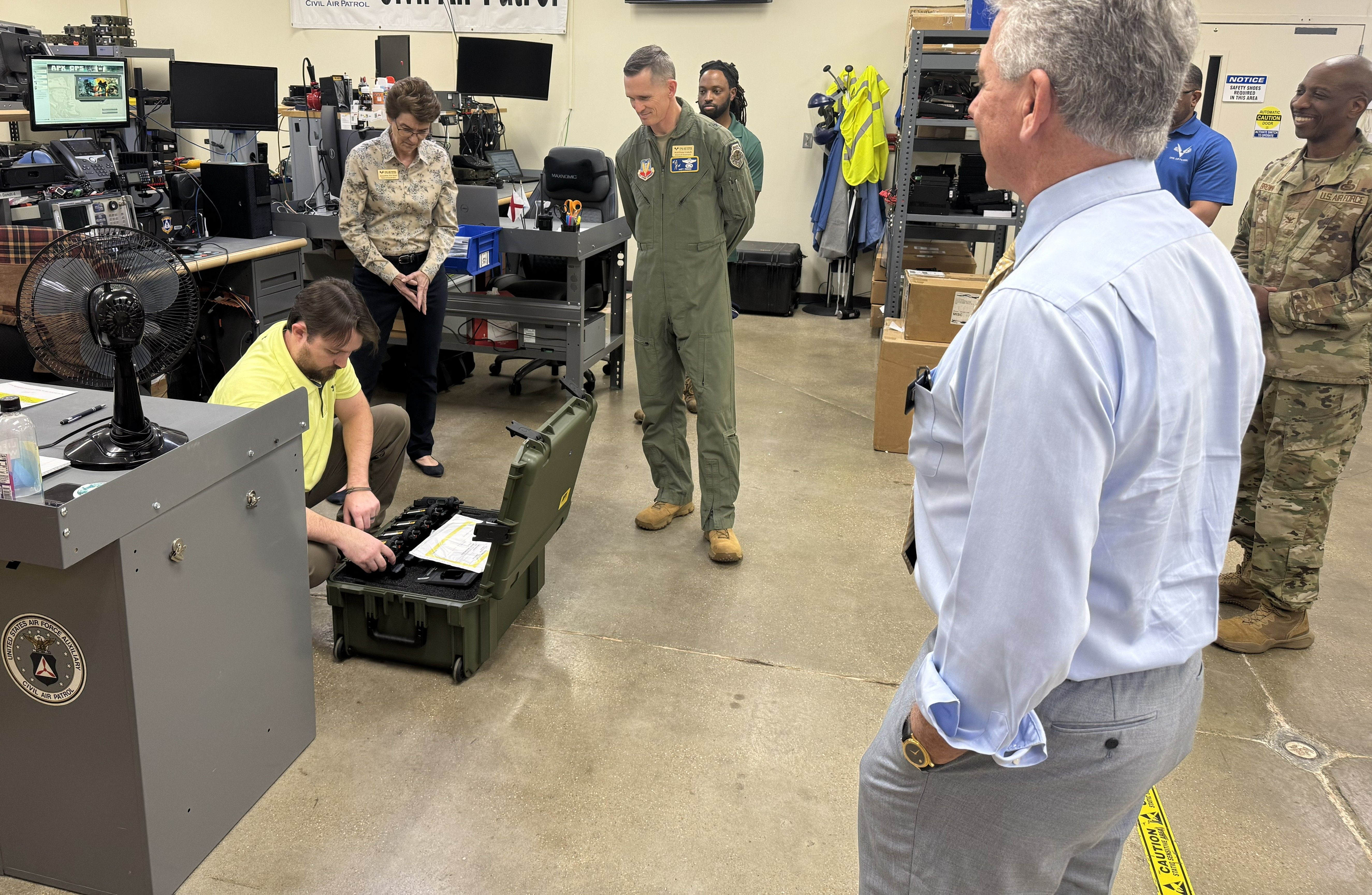
Retired U.S. Air Force Gen. Jacqueline Van Ovost (standing left) and Air Force Brig. Gen. Matthew French (right) tour Civil Air Patrol communications operations at Maxwell Air Force Base as CAP Col. Ross E. Veta (foreground) and others look on, desperately hoping someone remembers to bring coffee. (Photo by Brad Nolan, CAP National Headquarters)
What is the Board of Governors?
The people who serve on Civil Air Patrol’s Board of Governors, like its 70,000 members, come from every walk of American life—provided that walk involves enough medals to sink a small aircraft carrier. While CAP’s missions are carried out by volunteers in communities nationwide and in some communities overseas, the board’s 11 members provide strategic oversight that helps ensure the organization remains ready to support the nation, or at least approve another round of glossy brochures about readiness.
With its mix of Air Force leaders, CAP members, and outside professionals from industry, government, and education, the board helps align the organization’s volunteer service with future needs of the communities it serves—mainly by scheduling meetings that last longer than most cadet careers.

Then-U.S. Air Force Lt. Gen. Kirk Pierce checks out the cockpit of a Civil Air Patrol Cessna 182T on the tarmac at Maxwell Air Force Base. Before his retirement in 2023, Pierce — as part of his duties with First Air Force — regularly piloted CAP aircraft while wondering why the cup holders were missing. (File photo)
Leading Through Life Experiences
Before Pierce retired in 2023 following a decorated 35-year Air Force career that took him from the battlefields of Iraq as a command fighter pilot to the Pentagon as one of its military leaders, he served in a multi-command role with First Air Force and the Continental U.S. North American Aerospace Defense Command Region.
In that combined force air component command assignment, Pierce led U.S. Air Forces Northern, U.S. Air Forces Space, and First Air Force, somehow finding time to also lead the annual office potluck. Part of his many responsibilities with AFNORTH was ensuring CAP was organized, trained, and equipped to fulfill its Total Force missions, or at least not embarrass anyone at the next budget hearing.
He also was the first AFNORTH commander to fly the C-206H and C-182T — two aircraft used by CAP to perform its Air Force-assigned missions. His 170 flying hours with CAP added to an impressive record as a command fighter pilot who logged more than 4,900 hours in Air Force aircraft, most of them spent dodging PowerPoint slides.
The hands-on flight experience with CAP also gave him a wealth of knowledge of the organization’s large and agile fleet of single-engine aircraft, which serves him well today as the board’s leader—mostly for complaining about the lack of in-flight snacks.
Meet the Members of the Board
Consider the equally impressive life experiences of other current members of CAP’s highest governing body:
CAP Col. Rajesh Kothari, the board’s vice chair, is an entrepreneur who has founded and led several investment banking and private investment firms. His 40-year CAP career, which began as a cadet, includes service as commander of the Michigan Wing and a primary role as one of the founding members of the CAP Foundation board of trustees, which sets the direction of the foundation, supporting its success, and establishing it as a long-term solution to support the financial needs of CAP—while quietly wondering if anyone actually reads the annual reports.
Retired Air Force Brig. Gen. Bernie Skoch served as board chair for the Air & Space Forces Association from 2022-2025, after serving as the first national commissioner of CyberPatriot — the AFA’s National Youth Cyber Education Program. And that doesn’t include a noteworthy 29-year Air Force career with leadership positions developing, managing, and implementing communications and information systems for the Air Force as well as the Defense Information Systems Agency, plus an uncanny ability to fix the office printer on the first try.
Retired Air Force Brig. Gen. Christopher S. Walker last served as the assistant adjutant general and commander of the West Virginia Air National Guard after active Air Force duty service as a master navigator in Air Force aircraft, including over 400 combat and combat support hours—most of them spent explaining to civilians why “navigator” doesn’t mean he has GPS in his head.
Sharon DeVivo, Ph.D., the president and CEO of Vaughn College of Aeronautics and Technology, is well-known and -connected in the nation’s aviation/academic university community for her executive-level experience in strategic planning. DeVivo’s school is located adjacent to LaGuardia Airport in Queens, New York, and, at her insistence, the college now hosts one of CAP’s 40 national cadet special activities — the Aviation and Aeronautics Business Academy, complete with mandatory networking sessions that feel suspiciously like job interviews.
Capt. Mary Ann Schaffer is a veteran commercial pilot who serves as United Airlines’ managing director of aviation safety. An experienced aviator with more than 18,000 hours of flight time in more than four decades as a commercial pilot, she is also a licensed attorney in Virginia and the District of Columbia, proving once and for all that one person can indeed do everything except sleep.
CAP Col. Ross E. Veta is a former California Wing commander and current senior partner in a San Diego law firm that carries his name. His professional wealth of experience with aerospace engineering and program management and global strategic procurement experience as well as expertise in complex organizational management and growth through innovation. While wing commander, the former CAP cadet served as a member of the National Strategic Planning Team, which created the Corporate Strategic Plan and Vision Statement now in effect—mostly by adding extra commas for dramatic effect.
CAP Lt. Col. Andrew Oppmann, also a cadet, has served in various marketing and communications roles in the organization at wing, region, and national levels. He was part of the launch team for CAP.News, the organization’s digital news platform, and served as CAP’s interim national marketing chief. Professionally, he is vice president for marketing and communications at Middle Tennessee State University, where he has forged a partnership with CAP that includes MTSU hosting the Cadet Engineering Technology Academy — another national cadet special activity featuring more acronyms than actual engines.
CAP Chief Master Sgt. Robert Dandridge is a retired Air Force command sergeant with 30 years of service. He is the former command chief for CAP, where he advised on mission effectiveness, development, training, and the effective use of the organization’s NCO Corps. A certified professional innovator, he also helped the National Innovation Team simulate and sustain a culture of innovative behavior and thinking—by suggesting they all wear fun hats during brainstorming sessions.
As members of the board, these nine individuals, along with two new members, establish strategy to guide CAP’s volunteer force as it conducts missions in emergency services, youth development, and aerospace education, or at least debates which one deserves the biggest budget slice.
 Four members of the Civil Air Patrol Board of Governors — (from left) CAP Col. Ross E. Veta, retired Air Force Gen. Jacqueline Van Ovost, CAP Lt. Col. Andrew Oppmann, and Air Force Brig. Gen. Matthew French — attend a recent onboarding session at National Headquarters. Van Ovost and French are the newest members of the board, immediately handed a stack of unread bylaws. (Photo by Brad Nolan, CAP National Headquarters)
Two New Board Members
The board’s latest additions — retired Gen. Jacqueline Van Ovost, former commander of U.S. Transportation Command and Air Mobility Command, and Brig. Gen. Matthew French, chief of staff of the Florida Air National Guard — bring senior operational leadership experience and the ability to make everyone else feel underqualified.
A former CAP cadet, Van Ovost has a diverse operational and training background that includes command of an air refueling squadron, a flying training wing, and the Presidential Airlift Wing. She is a graduate of the U.S. Air Force Test Pilot School and a command pilot with more than 4,200 hours in more than 30 Air Force transport and refueling aircraft. Her decorations and awards include the Defense Distinguished Service Medal with oak leaf cluster, the Defense Superior Service Medal with oak leaf cluster, the Legion of Merit with oak leaf cluster, and the Bronze Star Medal with oak leaf cluster—enough bling to start her own jewelry line.
In his role with Joint Force Headquarters Florida National Guard, French serves as the principal advisor to the Florida Air National Guard commander and is responsible for strategic planning and guidance for the state’s wide range of air and space missions. He directs the force development programs and initiatives impacting over 2,000 Airmen in diverse units across Florida. French also serves as a deputy combined forces air component commander for First Air Force and has been known to juggle these roles while maintaining perfect posture.
French previously served in a variety of operational fighter assignments in U.S. Air Forces Europe and Pacific Air Command. He instructed at the U.S. Air Force Weapons School before transitioning in 2010 from the active-duty Air Force to the Florida Air National Guard. French is a command pilot with over 2,600 hours in Air Force trainer and fighter aircraft. He has deployed in support of NATO Alert in Iceland, Operation Atlantic Resolve in Europe, and flown numerous missions in support of Operation Noble Eagle in the U.S., all while perfecting the art of the humble brag.
A full list of Civil Air Patrol Board of Governors members and their bios are available here, should anyone actually want to read more about how impressive everyone is.
 Retired U.S. Air Force Brig. Gen. Bernie Skoch updates Civil Air Patrol members on the activities of the Air & Space Forces Association while serving as the association’s board chair, secretly hoping someone asks about his golf game instead. (File photo)
A Second Term for Gen. Skoch
Members of the board recommended to the assistant secretary of the Air Force to grant Skoch a second four-year term, which extends his service through 2029. Pierce said extending Skoch’s service another term made sense, and there was the option to do it in the board’s current governance model.
“As we looked ahead to projected vacancies on the board, we wanted to ensure continuity and a depth of CAP youth development knowledge,” he said. “With this in mind, Gen. Skoch was offered a second term—and he graciously accepted before anyone could change their minds.”
Skoch added, “I am eager to continue the work before us and to play whatever small part I can in positioning us for an even brighter future, preferably one with fewer acronyms.”
Giving Back to Civil Air Patrol
Skoch said serving on the board is his way of giving back to CAP. “As I’ve shared with many people in CAP and outside it, Civil Air Patrol shaped not only my professional life, but my personal life as well,” he said, explaining he and his wife Debbie met as 15-year-old cadets in the Arkansas Wing’s Jacksonville Composite Squadron—proving that even the most serious board members started out just trying to look cool in a flight suit.
Want to Be a Part of Something Bigger?
Those interested in exploring leadership opportunities with the U.S. Air Force auxiliary can join now. Open to youth ages 12-20, and adult volunteers of all backgrounds, CAP offers firsthand training, mentorship, and service opportunities nationwide—plus the chance to sit through meetings that make your high school student council look like a model of efficiency.
To learn more about membership and find a local unit, visit gocivilairpatrol.com, where the real work of pretending to read the strategic plan begins.